


Why Do We Integrate Psychoanalysis with Psychedelic Medicine?

Updated: Nov 4
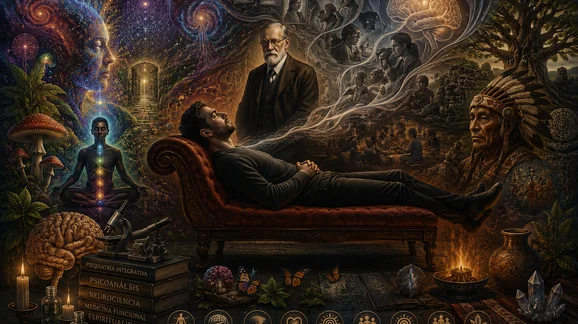
It may seem an unlikely combination: on one side, Freudian psychoanalysis, with its emphasis on speech, transference and meticulous work with the unconscious through free association. On the other, psychedelic medicine, with its non-ordinary states of consciousness and mystical experiences that allow a temporary dissolution of the ego.
What do a couch and a ketamine session have in common? Why do we at Kaapi insist on this integration?
The short answer: because both seek the same thing by different paths, and together they are far more powerful than apart.
The Shared Goal: Making the Unconscious Conscious
When Freud wrote that "Few experiences transform psychic life as much as discovering what remained unconscious", he was describing something that sacred plant traditions have facilitated for millennia: access to psychic contents that are usually inaccessible.
Psychoanalysis and psychedelics share a fundamental conviction: psychic suffering is not resolved only on the surface of consciousness. Symptoms —depression, anxiety, destructive relational patterns, addictions— are expressions of conflicts, traumas and dynamics that operate outside our ordinary consciousness.
For genuine transformation, we need to reach those depths. Psychoanalysis and psychedelics are two methods for doing precisely that.
Psychoanalysis: Patient Excavation of the Unconscious
The traditional psychoanalytic method is slow and meticulous. Through free association —saying everything that comes to mind without censorship— the following gradually emerge:
Forgotten or repressed memories: Early experiences that shaped current patterns of relating and suffering.
Unconscious desires: Longings, needs and impulses that consciousness censors or disguises.
Defense mechanisms: The sophisticated ways in which the psyche protects itself from painful truths —denial, projection, rationalization, dissociation.
Transference: How we repeat relational patterns from the past in the therapeutic relationship, offering a unique opportunity to observe and modify them.
The unconscious meaning of symptoms: Why depression appears right now, what function anxiety serves, what conflict the somatic symptom expresses.
This process takes time —often years— precisely because psychic defenses exist for valid reasons. Dismantling them hastily can be destabilizing. Psychoanalysis respects the rhythm of the psyche, gradually builds the capacity for containment and creates a therapeutic bond strong enough to hold whatever emerges.
As Erich Fromm observed: "Analysis is not a method for adapting, but a path toward the discovery of oneself". That discovery cannot be rushed.
Psychedelics: A Dramatic Amplification of Psychic Processes
Now, what do substances such as ketamine or psilocybin contribute?
Stanislav Grof, who worked extensively with LSD in psychotherapy before its prohibition, put it this way: "Psychedelics amplify mental processes. Used properly, they could become for psychiatry what the microscope is for biology or the telescope for astronomy".
In psychedelic states, the usual filters of consciousness temporarily relax. This can facilitate:
Rapid access to unconscious material: Memories, emotions and insights that could take months or years in conventional therapy may appear in a session of a few hours.
Temporary reduction of defenses: The partial dissolution of the ego makes it possible to observe one's own patterns with unusual objectivity. It is like being able to step out, for a moment, of the narrative in which we are trapped and see it from the outside.
Corrective emotional experiences: Reliving traumas or conflicts in a safe context, with a new perspective, can facilitate processing that has been blocked.
Loosening of rigid patterns: Psychedelic-induced neuroplasticity is not merely metaphorical. There are measurable changes in brain connectivity that correlate with greater psychological openness.
Mystical or transcendent experiences: These can offer perspective on one's own suffering, renew a sense of purpose and reconnect with deep values.
As Alexander Shulgin warned: "Psychedelics show you nothing that is not already within you. They only allow you to see it without your usual defenses".
The Problem with Psychedelics Without Deep Psychotherapy
Here is the crucial point: psychedelics alone are not enough.
It is possible to have deep, even mystical, psychedelic experiences that do not translate into sustained change in everyday life. Why?
No interpretive framework: Experiences can be overwhelming, confusing and difficult to translate into relevant personal meaning.
No sustained processing: An insight during the session is not the same as integrating that insight into patterns of behavior, beliefs and relationships.
No work with resistance: Even after clearly seeing a destructive pattern, resistance to change persists. Genuine change requires sustained work with that resistance.
No working-through of traumatic content: Accessing trauma is not the same as processing it. It takes time, repetition and gradual working-through in a safe context.
No attention to transference: The relational patterns activated during and after psychedelic sessions need to be worked on within the therapeutic relationship.
As Jung pointed out: "These substances can reveal the unconscious, but they cannot replace the process of integration, which requires work and responsibility".
The Synthesis: Psychedelic-Assisted Psychoanalysis
At Kaapi, we integrate both methods so that they strengthen each other:
Before the Psychedelic Session
Prior psychoanalytic work establishes:
Therapeutic bond: The deep trust needed for vulnerable experiences is built over time.
Areas of conflict: We clarify which questions the patient brings, which patterns we want to explore and which unconscious material seems most relevant.
Capacity for containment: We strengthen the ego's capacity to hold intense material without being overwhelmed.
Interpretive framework: The patient already has psychoanalytic tools to make sense of whatever emerges.
During the Psychedelic Session
The psychoanalytically trained therapist:
Accompanies without directing: Maintains presence and containment without imposing interpretations.
Observes transference dynamics: Attends to how relational patterns are activated, even in an altered state.
Records material for later work: The patient's phrases, emerging themes and predominant emotions.
After the Psychedelic Session
The psychoanalytic integration work includes:
Working through the emerging material: We use free association on the experiences of the psychedelic session. What resonances does it have with the personal history? What memories does it connect? What conflicts does it illuminate?
Psychodynamic interpretation: We help the patient understand the deep meaning of what was lived in relation to their psychic structure, their defenses and their relational patterns.
Work with resistance: The resistance to change that emerged during the psychedelic experience is explored in later sessions.
Translation into life patterns: Insights become concrete changes in behavior through sustained analytic work.
Long-term process: We continue the analysis for months or years, using the psychedelic experiences as rich material for deep work.
A Clinical Example (Anonymized)
A patient with treatment-resistant depression and a pattern of sabotaged intimate relationships. Six months of psychoanalytic psychotherapy revealed an insecure bond with an emotionally inconsistent mother and a defensive mechanism of anticipatory detachment ("I leave them before they leave me").
During the ketamine session: access to emotionally charged childhood memories. An experiential (not merely intellectual) insight into how the protective childhood mechanism had become an adult prison. An experience of deep connection that contradicts the inner narrative of "not being worthy of love".
Subsequent psychoanalytic integration (12 sessions over 3 months):
Working through the activated memories.
Work with ambivalence about giving up the defense of detachment.
Processing grief for years lost in repetitive patterns.
Gradual experiments with vulnerability in the therapeutic relationship (transference).
Generalization to relationships outside therapy.
Result: Not only symptomatic improvement (depression), but structural change in the capacity for intimacy. Three years later, the transformation has been sustained.
What Psychoanalysis Brings to Psychedelic Medicine
Interpretive depth: Not everything is chemical. Experiences have psychic meaning that must be worked through.
Attention to transference: The therapeutic relationship is the laboratory where relational patterns are modified.
Work with resistance: Real change requires actively working against intrapsychic forces that favor the status quo.
Sustained process: Transformation is not a single event, but a long-term process.
Understanding of defense: Respect for the unconscious reasons why the psyche organizes itself as it does.
As Freud wrote: "The ego is not master in its own house". Psychoanalytic work helps the ego expand, to integrate more of what was dissociated or repressed.
What Psychedelics Bring to Psychoanalysis
Accelerated access: Material that could take years to emerge may appear in sessions.
Lived experience vs. intellectual insight: Not only "knowing" but "feeling" truths about oneself in the body.
Loosening of rigid structures: Both neurological and psychic.
Powerful corrective experiences: Moments of connection, transcendence and forgiveness that can act as pivots of transformation.
Renewed motivation: Mystical or meaningful experiences can revitalize commitment to the therapeutic process when it stalls.
As Grof observed: "Psychedelics open the unconscious in a way that no other psychotherapeutic method can achieve".
It Is Not for Everyone
This integration requires:
Commitment to a long process: It is not a quick treatment. Psychedelic sessions are milestones in a process of months or years.
Willingness to go deep: There must be a genuine interest in self-knowledge, not only in symptom reduction.
Capacity for introspection: The work requires being able to observe oneself, tolerate ambiguity and hold psychic tension.
Sufficient stability: Certain conditions (active psychosis, severe instability) are contraindications.
Intrinsic motivation: It must be a personal choice, not external pressure.
An Invitation to Depth
In a world that looks for quick fixes, at Kaapi we offer something different: deep transformation that requires time, work and courage.
We combine the most refined method for exploring the unconscious that the West has developed (psychoanalysis) with ancestral tools for accessing expanded states of consciousness (psychedelic medicine).
We do not promise a miracle cure. We promise rigorous and compassionate accompaniment in a process of self-knowledge that can be demanding but deeply liberating.
As Viktor Frankl pointed out: "When we are no longer able to change a situation, we are challenged to change ourselves". This deep change of oneself is what we facilitate.
Does This Approach Resonate With You?
If you feel that this integration of psychoanalysis and psychedelic medicine could be your path:
Read our blog post on What Is Ketamine-Assisted Therapy.
Download the Information Guide about our therapeutic approach.
Book an assessment consultation to explore whether you are a suitable candidate.
Meet Dr. Joel Klahr, the psychiatrist and psychoanalyst who leads this work.
Follow us on social media where we share reflections on psychoanalysis, psychedelics and transformation:
Instagram: @kaapi_center
LinkedIn: Kaapi - Center for Integrative Psychiatry
Subscribe to "Bajo el Efecto", where we will explore these topics in depth.
Connection · Introspection · Transformation
References
Freud, S. (1915). "The Unconscious". Complete Works.
Grof, S. (2008). LSD Psychotherapy. MAPS.
Nielson, E. & Guss, J. (2018). "The influence of therapists' first-hand experience with psychedelics on psychedelic-assisted psychotherapy research and therapist training". Journal of Psychedelic Studies.
Carhart-Harris, R. & Friston, K. (2019). "REBUS and the Anarchic Brain: Toward a Unified Model of the Brain Action of Psychedelics". Pharmacological Reviews.
Roseman, L. et al. (2019). "Psychedelics, Meditation, and Self-Consciousness". Frontiers in Psychology.


Comments