


Our Vision: Science and Ancestral Wisdom in Dialogue

There is a false dichotomy in the field of mental health: on one side, "modern" medical science with its protocols, randomized trials and synthetic molecules; on the other, "ancestral" traditions with their ceremonies, sacred plants and age-old worldviews.
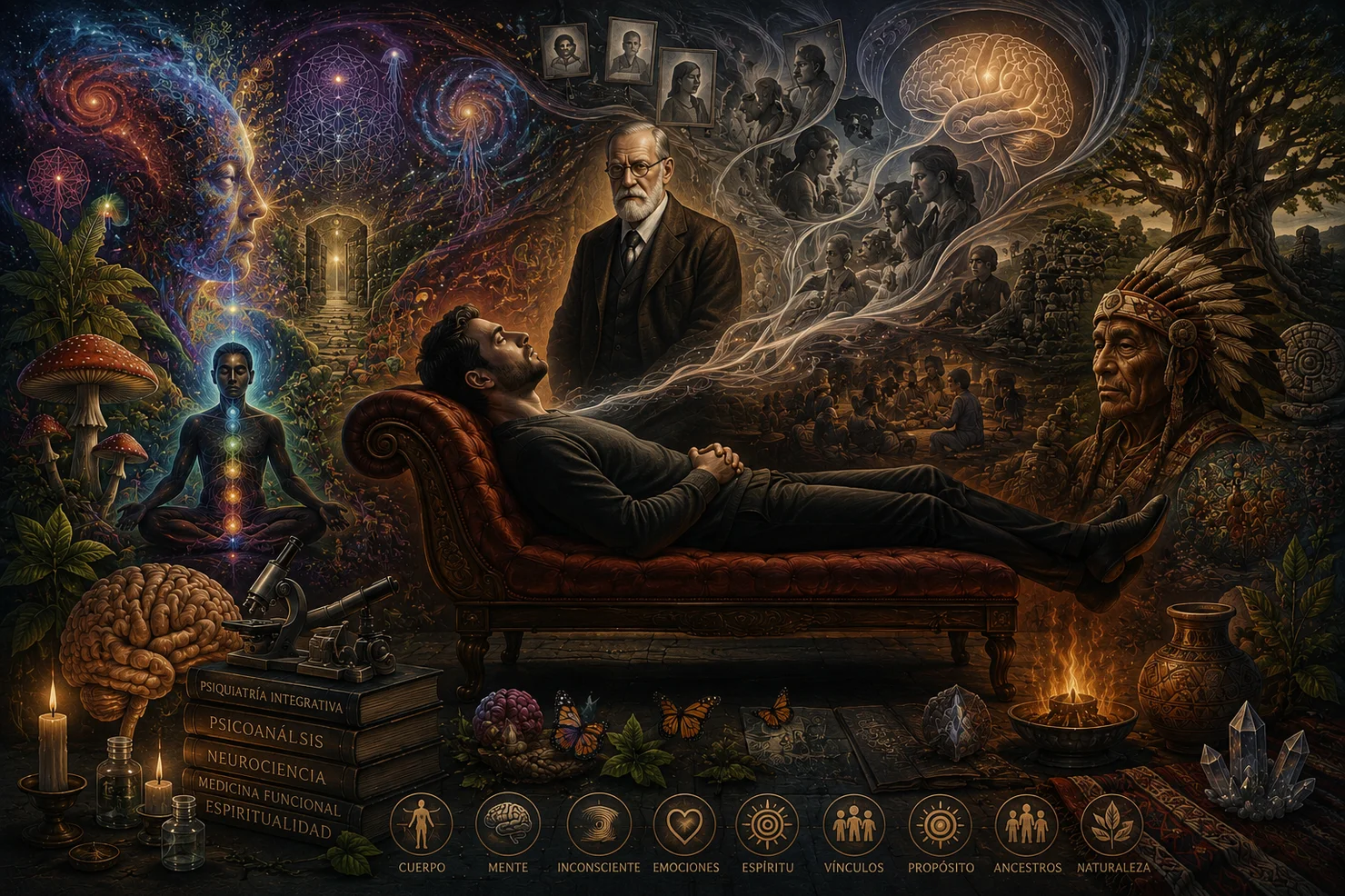
At Kaapi, we reject this artificial division. We believe that the true medicine of the future —and of the present— emerges precisely from a respectful dialogue between these two forms of knowledge.
The Historical Moment We Are Living
We are witnessing what many call the "psychedelic renaissance." After decades of prohibition and stigma, the world's leading scientific institutions are rediscovering the therapeutic potential of substances that Indigenous peoples have used as sacred for millennia.
Johns Hopkins University, Imperial College London, the University of California, MAPS (Multidisciplinary Association for Psychedelic Studies) and dozens of prestigious institutions are publishing studies that confirm what Huichol shamans, taitas of the Putumayo and Mazatec healers have always known: that these medicines, used with respect, preparation and in appropriate contexts, can facilitate profound transformations.
But here is the crucial point: it is not a matter of science "validating" ancestral traditions, as if they needed outside approval. It is about recognizing that both forms of knowledge offer complementary perspectives on the same reality: the human capacity for transformation and transcendence.
What Science Contributes
The scientific method gives us invaluable tools:
Safety and medical protocols: Understanding pharmacokinetics, drug interactions, contraindications and precise dosing. Knowing who is an appropriate candidate and who is not. Monitoring vital signs and managing potential complications.
Systematic evidence: Controlled studies that demonstrate efficacy in specific conditions. Long-term follow-up of outcomes. Identification of data-driven best practices.
Understanding of mechanisms: Neuroplasticity, brain connectivity and neurotransmitter systems. How these substances act at the molecular level and which brain changes correlate with therapeutic improvement.
Democratized access: Synthesis of pure compounds, standardized doses and the possibility of bringing these treatments to urban populations who have no access to ceremonial traditions.
Ethical and legal framework: Regulations that protect vulnerable patients, standards of professional practice and institutional oversight.
As Albert Hofmann, the chemist who synthesized LSD, put it: "Scientific inquiry and spiritual experience are not opposites; they are two complementary ways of accessing reality."
What Ancestral Traditions Teach
However, science alone is not enough. Ancestral traditions carry knowledge that contemporary research is only beginning to appreciate:
The importance of ritual context: Set (the participant's state of mind) and setting (the physical and social environment) are not secondary variables but fundamental determinants of the experience. Traditional ceremonies create contexts carefully designed over generations to maximize benefit and minimize risk.
The role of community: In Indigenous traditions, these experiences are not individual but communal. There is collective support, transmission of shared meanings and social integration of what has been lived. Individualistic Western medicine can learn a great deal from this approach.
Respect and reciprocity with the plants: The traditions do not see these substances as mere chemical compounds but as beings with agency, with "spirit." This attitude of reverence creates a relationship with the medicine radically different from utilitarian consumption.
Cosmologies of meaning: The traditions offer rich interpretive frameworks to make sense of experiences that can be bewildering or ineffable. Not everything comes down to the activation of 5-HT2A receptors.
Patience and process: In ceremonial traditions, transformation is not expected from a single session. There are processes lasting years, long-term learning relationships with teachers, and slow, sustained integration.
Epistemological humility: Recognition that there is mystery, that not everything can be measured or explained, and that certain experiences transcend language and rational understanding.
As Paul Stamets expressed it: "We are connected to nature in ways we are only beginning to understand, and these medicines are one of the keys to that connection".
The Risk of Pharmaceutical Colonialism
We must be careful. There is a real risk that the "psychedelic renaissance" will reproduce colonial dynamics. This can include the West extracting knowledge and substances from Indigenous peoples, patenting molecules, marketing expensive treatments and appropriating age-old wisdom without recognition or reciprocity.
It is already happening: pharmaceutical companies are patenting synthetic variations of psilocybin, while the Mazatec communities that protected this knowledge for centuries receive no benefit. Ketamine clinics in the United States charge hundreds and even thousands of dollars per session, reproducing inequities in access.
At Kaapi, we consciously position ourselves against this trend. Our commitment includes:
Explicit recognition: We name and honor the traditions this knowledge comes from: the Huichol, the Amazonian peoples and the Mazatec.
Contextual education: When we talk about psilocybin or ayahuasca, we share their ceremonial history, not only their pharmacology.
Affordability: We work so that these treatments are not a privilege of urban elites but accessible to those who genuinely need them.
Support for Indigenous communities: Part of our vision for the future includes collaborations and direct reciprocity with the communities that are guardians of this knowledge.
Cultural humility: We do not claim to be shamans or appropriate ceremonial roles. We are psychiatrists, psychotherapists and facilitators in a modern clinical context, and we acknowledge the differences.
The Synthesis at Kaapi
What does this integration look like concretely in our practice?
Medical rigor with reverence:
We carry out thorough psychiatric assessments, obtain informed consent and monitor vital signs. We meet every medical standard.
But we also create ritualized spaces, speak of "medicine" and not only of "drug," and invite intention and respect.
Evidence-based protocols with flexibility:
We follow doses, frequencies and procedures validated by scientific research.
But we adapt the process to each individual, honoring their cultural context, their beliefs and their unique process.
Psychoanalysis open to the transpersonal:
We use the tools of Freudian and dynamic psychoanalysis to understand the unconscious, defense mechanisms and repetitions.
But we also acknowledge mystical, transcendent and spiritual experiences that cannot be reduced to symbolism or sublimation. We integrate the perspectives of Jung, Grof and transpersonal psychology.
Professionalism with human warmth:
We maintain appropriate therapeutic boundaries, clinical documentation and supervision.
But we also offer genuine presence, vulnerability when appropriate and recognition of our shared humanity.
As Carl Rogers pointed out: "The curious paradox is that when I accept myself just as I am, then I can change". This acceptance requires both scientific understanding and deep human compassion.
Beyond Dualism
Ultimately, the distinction between "science" and "ancestral tradition" may itself be a Western cultural construct. Many Indigenous worldviews do not separate empirical knowledge from spiritual knowledge, observation of nature from reverence for it, technique from ritual.
Perhaps what we need is not so much to "integrate" two separate things, but to recognize a more holistic way of knowing and healing that should never have been fragmented. Erich Fromm, a psychoanalyst who engaged in deep dialogue with Zen Buddhism, wrote: "Zen Buddhism and psychoanalysis agree that healing is only possible when one faces one's inner experience without evasion".
That unflinching encounter can benefit as much from functional neuroimaging as from ceremonies with copal. From models of neuroplasticity as from ancestral chants. From psychopharmacology as from fasting and ritual preparation.
An Invitation
We believe that the future of mental health —particularly in Latin America, where age-old traditions coexist with modern medical institutions— lies in this respectful synthesis.
It is not about romanticizing ancestral traditions while ignoring their limitations, nor about imposing Western scientific protocols as the only valid model. It is about a genuine dialogue in which both perspectives enrich each other.
At Kaapi, every patient is invited into this dialogue. You bring your history, your suffering and your existential questions. We offer both the tools of contemporary integrative psychiatry and respect for dimensions of human experience that transcend what can be measured.
As Ram Dass used to say: "We are all just walking each other home". On that path back to ourselves, to our center, to our authenticity, we need all the wisdom available —ancient and new, scientific and spiritual, rational and intuitive.
Continue the Conversation
If this vision resonates with you:
Explore our services in integrative psychiatry and psychedelic-assisted therapy
Read our Information Guide about our therapeutic approach
Follow us on social media where we share reflections on science, tradition and transformation:
Instagram: @kaapi_center
LinkedIn: Kaapi - Center for Integrative Psychiatry
Subscribe to "Bajo el Efecto", our upcoming podcast where we will explore these dialogues in depth
Connection · Introspection · Transformation

Comments